
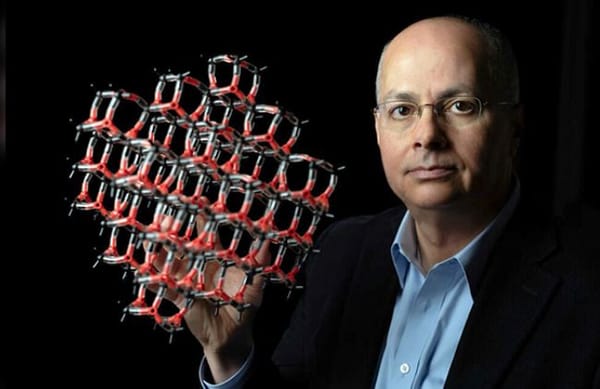
Nobel Honors Omar Yaghi for Chemistry Breakthrough Metal Organic Frameworks (MOFs). This advance offers potential to create clean water from air and address global water security.
Berkeley, CA — October 8, 2025 — Omar M. Yaghi, a professor of chemistry at the University of California, Berkeley, has been awarded the 2025 Nobel Prize in Chemistry for pioneering a new class of crystalline materials that may hold the key to solving two of humanity’s most urgent challenges — capturing carbon and extracting clean water from air.
Unlike condensation-based machines that require large amounts of electricity to chill air, Yaghi’s MOF-based devices rely on adsorption, capturing water molecules directly into the material’s pores. A mild rise in temperature — ideally from solar energy or waste heat — releases the trapped vapor, which then condenses into drinkable water. The process can repeat hundreds of times with minimal power, offering a path toward carbon-neutral, off-grid water access.
Yaghi shares the Nobel with Japan’s Susumu Kitagawa and Australia’s Richard Robson for their invention and development of metal–organic frameworks (MOFs), ultra-porous compounds capable of storing gases, trapping pollutants, and harvesting water molecules even in the driest desert air. The Royal Swedish Academy of Sciences hailed the trio’s work as “a revolution in reticular chemistry,” likening the atomic sponge-like materials to “Hermione’s handbag” for their astonishing internal capacity.
Leading researchers and industry partners view MOFs as a foundational platform technology: tunable “molecular architecture” that can capture carbon, harvest water from air, remove toxic pollutants, and store critical gases.
Many believe this could enable entirely new industries in water, climate resilience, and clean energy, in much the same way that transistors, synthetic polymers, and semiconductors unlocked whole new industrial eras.
For Yaghi, the recognition crowns three decades of research that reimagined chemistry’s role in addressing global resource scarcity. “Our goal is to make materials that work for people — that pull water from air, wherever you are,” he said in a recent interview. “The science is about enabling life where water does not naturally exist.”
Born in Amman, Jordan, in 1965 and educated in the United States, Yaghi built his career on the concept of reticular chemistry — assembling molecular building blocks into ordered frameworks with enormous surface area. While initially explored for hydrogen storage and carbon capture, Yaghi’s curiosity turned toward the planet’s growing water crisis.
At his UC Berkeley laboratory, and through his startup Atoco, Yaghi leads research into atmospheric water generation (AWG) systems that use MOFs to absorb humidity from the air and release it as clean liquid water when gently heated. His team’s prototypes have already demonstrated the ability to produce potable water in humidity levels as low as 10 percent — conditions typical of arid regions and conflict zones where conventional filtration or desalination is impossible.
Yaghi aims to transition this research from laboratory to market, developing modular systems for households, military operations, and remote communities. The company is also advancing related frameworks for carbon dioxide capture, leveraging similar chemistry to address climate change on multiple fronts.
A company that has advanced this technology significantly is London based Ahbstra Engineering which is profiled on the Davos Technology Platform.
While commercial scale-up remains a challenge — MOF production costs, durability, and manufacturing logistics still limit widespread deployment — Yaghi’s Nobel recognition is expected to accelerate global investment in adsorption-based AWG. The breakthrough not only validates decades of fundamental chemistry but also promises a tangible humanitarian impact.
“Imagine a world where every home has a box that makes its own water,” Yaghi has said. “That future is no longer science fiction — it’s chemistry.”
To learn more about the Ahbstra which is the leader in commercializing MOFs in the water generation see LINK.
Comments
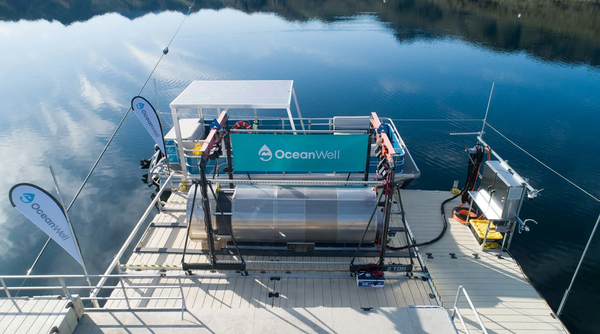
OceanWell Taps Deep Ocean to Redefine Sustainable Desalination
Water scarcity is rapidly becoming one of the most pressing global challenges, driven by climate change, population growth, and declining freshwater reserves. While desalination has long been seen as part of the solution, conventional systems remain energy-intensive, land-heavy, and environmentally controversial. OceanWell is advancing a new approach that rethinks how
Revolutionizing Water Management: How Technology is Tackling Water Waste in Buildings.
Shayp client ING went live in 2022 and has already saved over 3 million litres per year. In a couple of months, they were able to avoid 473 kg of carbon emissions by just monitoring their water and taking action efficiently.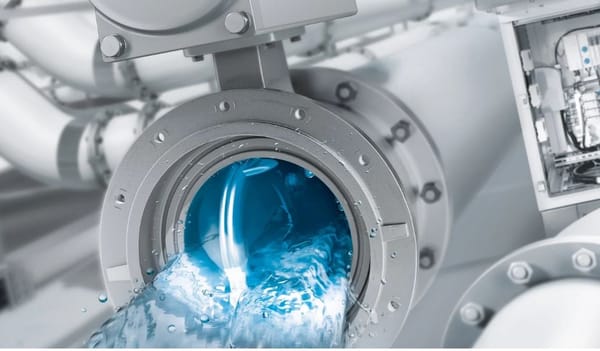
New Ecosystem Resource Directory Launched to Support Water Technology Companies Worldwide
A new Ecosystem Resource Directory is being developed to support water technology companies working to scale breakthrough innovations and proven solutions across the global water sector. The initiative aims to create a comprehensive, practical inventory of resources available to companies navigating the complex journey from innovation to market scale. By
E-Waste Emerges as a Major Circular Economy Challenge for Governments and Industry
Electronic waste has become one of the fastest-growing waste streams in the world, driven by rising demand for consumer electronics, shorter device lifespans, and rapid digitalization across industries. Smartphones, laptops, appliances, and connected devices are replaced at unprecedented rates, generating mounting pressure on waste systems that were never designed to
Fixing One of Healthcare’s Biggest Blind Spots With Smart Medication Technology
Modern healthcare excels at diagnosing disease and prescribing treatment, yet what happens after a prescription is written often remains invisible. Whether patients take the right medication, at the right dose, and at the right time is largely assumed rather than verified. This gap between prescription and real-world use contributes to
AEIR to Debut Long-Range Wireless Energy Transfer System in Zurich on December 15
Lucerne, Switzerland — AEIR announced today that it will conduct the first public demonstration of its long-range Wireless Energy Transfer (WET) system in Zurich on December 15, 2025. The debut marks a major milestone for the Swiss-based company, which has spent several years developing a technology capable of transmitting power safely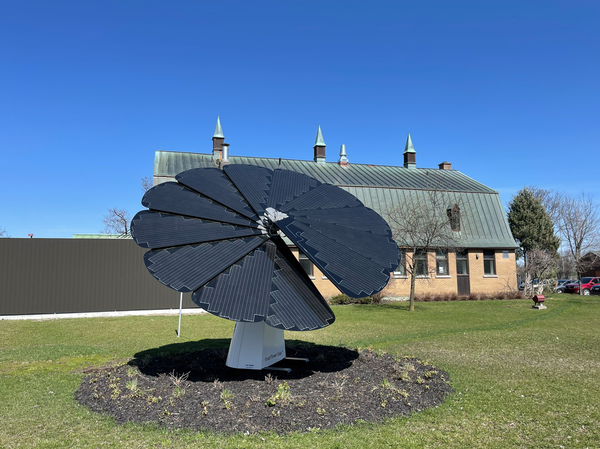
WattByWatt Uses Next-Generation Solar Materials to Power the World One Watt at a Time
As connected devices multiply and demand for clean electricity grows, the limitations of conventional solar technology are becoming more apparent. Traditional silicon panels are efficient at scale, but they are often rigid, energy-intensive to manufacture, and poorly suited for low-power or indoor applications. WattByWatt, a Canadian clean energy company, is
OceanWell Taps Deep Ocean to Redefine Sustainable Desalination
Water scarcity is rapidly becoming one of the most pressing global challenges, driven by climate change, population growth, and declining freshwater reserves. While desalination has long been seen as part of the solution, conventional systems remain energy-intensive, land-heavy, and environmentally controversial. OceanWell is advancing a new approach that rethinks how